
May 28, 2026
.png?width=1070&height=602&name=Copy%20of%20Copy%20of%20KAPITAL%20Sales%20Report%20(3).png)
 Most organizations treat Oracle Cloud hiring as a staffing problem. Fill the seat. Hit the timeline. Move on.
The strongest organizations treat it as something else entirely, a long-term enterprise capability strategy.
That distinction is becoming more important by the quarter. Oracle Cloud environments are more integrated, more business-critical, and more demanding than they were even three years ago. Execution quality now matters as much as implementation speed.
The companies moving fastest are not the ones with the biggest teams or the most aggressive hiring budgets. They are the ones building teams that can sustain transformation over time — through leadership changes, platform updates, and shifting business priorities.
In other words, they are building Oracle Dream Teams.
Hiring Talent Is Not the Same as Building a Team
Oracle Cloud has changed significantly over the past decade. What once revolved around implementation milestones now extends into continuous optimization, quarterly release management, integrations, governance, testing discipline, and long-term scalability.
In that environment, team dynamics matter as much as individual credentials. A technically strong hire can still slow things down if they cannot navigate stakeholder complexity, adapt to the organization's operating rhythm, or grow as the platform evolves.
Conversely, some of the most impactful Oracle professionals are not the most polished interviewees. Their value compounds over time, through consistency, sound judgment, and the trust they build across the organization.
.png?width=1366&height=452&name=White%20and%20Red%20Modern%20Testimonial%20Instagram%20Post%20%20(1).png)
That is the challenge inside modern Oracle environments. Implementation is rarely the hardest part. The harder part is building a team capable of sustaining execution quality as the environment keeps evolving.
Why Oracle Hiring Looks Different Today
Organizations are no longer managing static ERP systems with predictable upgrade cycles. They are running continuously evolving ecosystems, where finance, HR, supply chain, integrations, analytics, and automation are deeply interconnected.
That reality has raised the bar on what Oracle professionals are expected to do. The best ones today can:
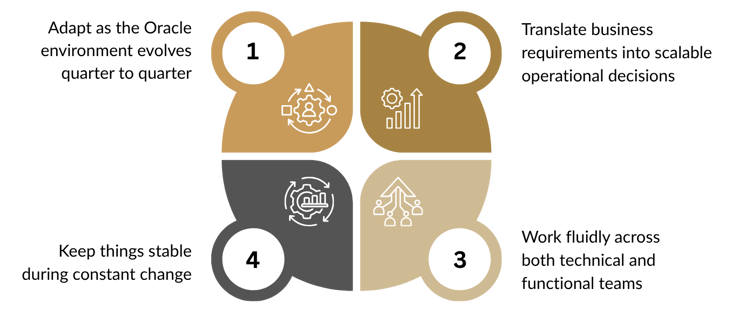
For many leadership teams, this is reshaping how Oracle talent is evaluated. The question is no longer just 'Can this person do the job today?' It is 'Can this person grow into what we need two or three years from now?'
The Organizations Moving Fastest Are Thinking Longer-Term
A clear pattern is emerging among organizations that are building high-performing Oracle Cloud teams: they are prioritizing durability over speed.
They are asking harder questions during the hiring process. Not just whether someone can solve today's problem, but whether they can keep creating value through future transformation cycles, through leadership transitions, platform changes, and organizational growth.
This shifts what gets evaluated. Technical depth still matters. So does pedigree. But increasingly, organizations are looking for qualities that traditional hiring processes miss: learning orientation, resilience under pressure, adaptability, and the ability to strengthen execution environments over time.
.png?width=1366&height=390&name=White%20and%20Red%20Modern%20Testimonial%20Instagram%20Post%20%20(2).png)
Inside Oracle ecosystems, where release cycles, integrations, governance expectations, and business priorities are always shifting, this mindset is one of the clearest predictors of long-term impact.
Capability Architecture: A Concept Worth Taking Seriously
One of the more important shifts happening inside Oracle organizations is this: leadership teams are starting to apply the same intentionality to talent architecture that they already apply to technology architecture.
They invest enormous effort in designing integration frameworks, governance models, security structures, and migration roadmaps. They are now recognizing that execution quality depends just as heavily on how expertise is distributed across the organization.
The questions they are asking include:
.png?width=1000&height=365&name=Adapt%20as%20the%20Oracle%20environment%20evolves%20quarter%20to%20quarter%20(1).png)
The organizations asking these questions early tend to be the ones best positioned to sustain momentum over time.
Why Traditional Hiring Often Misses the Best People
The strongest Oracle professionals are rarely visible through conventional channels for long. They are deeply embedded in transformation programs, trusted internally, and selective about where they invest their time and energy.
Reaching them requires more than a job posting or a recruitment blast. It requires patience, credibility, and conversations built around long-term alignment.
Standard interviews often reward polish and rehearsed confidence. Long-term enterprise impact is built on different qualities altogether: consistency, judgment, humility, and the ability to bring stability to complex environments.
The organizations building the strongest Oracle teams understand this clearly. They hire for sustained contribution, not short-term impressiveness.
Why This Matters Now
Oracle Cloud environments are becoming more interconnected and more operationally critical every year. The pressure on teams will only increase, absorbing continuous updates, maintaining governance, supporting integrated business operations, and evolving without disrupting execution momentum.
Technology will always be foundational. But over time, the organizations that execute best will be the ones with the strongest capability architecture behind the platform.
That is why the smartest companies are no longer treating Oracle hiring as an HR process. They are treating it as a long-term enterprise strategy.
Because the organizations that move fastest are rarely the ones that hire the quickest.
They are the ones that build teams designed to stay, scale, and compound value over time.

