
March 26, 2026
For many higher education institutions, ERP transformation has been a long and ongoing journey rather than a single milestone.
Whether it’s modernizing legacy PeopleSoft environments, transitioning to Oracle Cloud, or stabilizing systems post-implementation, the focus has traditionally been on platforms, integrations, and funding approvals.
Those elements remain critical. But across universities, business schools, and multi-campus systems, a different pattern is becoming increasingly clear.
The success of these initiatives is now being shaped just as much by talent availability and capability as it is by technology.
The Unique Complexity of ERP in Higher Education
Higher education environments operate very differently from commercial enterprises.
They are highly decentralized, often spanning multiple campuses, departments, and governance structures. Decision-making is layered. Budgets are constrained and tightly monitored. And systems must support a diverse set of stakeholders, from faculty and administration to students and external partners.
In this context, ERP systems like PeopleSoft and Oracle Cloud are not just operational tools. They sit at the center of:
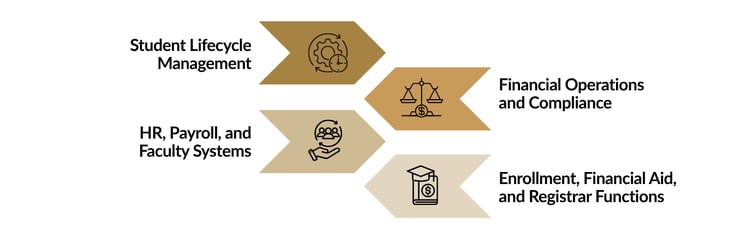
Even small disruptions can ripple across the institution.
As a result, ERP transformation in higher education is rarely about speed alone. It is about stability, continuity, and long-term sustainability.
Where Institutions Are Feeling the Pressure Today
Across conversations with higher education leaders, including many at HEUG, several themes consistently emerge.
Institutions are navigating a combination of legacy system dependencies and modernization goals. Many continue to operate critical workloads on PeopleSoft while simultaneously planning or executing a transition to Oracle Cloud.
This creates a dual challenge:
- Maintaining and supporting existing systems
- Building capability for future-state platforms
At the same time, institutions face constraints that are unique to the sector:
- Budget cycles that limit hiring flexibility
- Approval processes that extend timelines
- Difficulty competing with private sector compensation for niche ERP talent
- A growing reliance on a small number of internal experts
The result is not a lack of progress, but a constant balancing act between transformation and continuity.
“Across higher education, ERP transformation has evolved from a technology initiative into a long-term institutional capability. What I’ve seen through years of working alongside clients like the California State University, Office of the Chancellor, is that success is constrained by access to the right expertise at the right time. Institutions that create real momentum are those that treat talent as part of the strategy, not an afterthought. When that alignment exists, transformation becomes far more sustainable and far less disruptive.”
The Talent Challenge Beneath the Surface
In many institutions, ERP talent challenges do not appear as immediate blockers. They show up more gradually.
A key role takes longer to fill than expected.
An implementation phase relies heavily on contractors.
Internal teams carry increasing workloads to maintain system stability.
Over time, these patterns begin to influence how projects are sequenced and executed.
This is particularly evident in hybrid environments, where institutions must support both PeopleSoft and Oracle Cloud simultaneously. The skillsets required are different, but the expectation for continuity remains the same.
As a result, the question is no longer just “How do we implement or migrate?”
It becomes “How do we sustain and evolve these systems with the right people in place?”
Why Traditional Hiring Models Fall Short in This Space
Higher education institutions often operate with hiring models that were not designed for niche ERP ecosystems.
Roles in Oracle Cloud, PeopleSoft, integrations, and enterprise applications require a level of specialization that is difficult to assess through traditional recruitment approaches. At the same time, many of the most qualified professionals are not actively applying for roles, they are already embedded in similar environments.
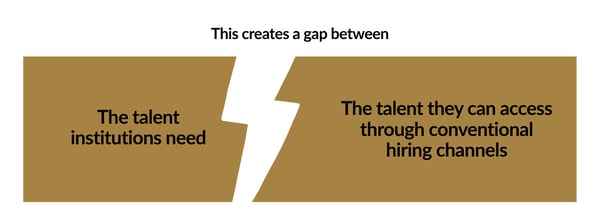
And when hiring cycles extend, the impact is not limited to HR metrics. It affects project timelines, system stability, and leadership confidence in execution.
A More Flexible Approach: Contract and Permanent Talent
In response, many institutions are moving toward more flexible talent strategies.
 Permanent hiring, on the other hand, focuses on building long-term institutional knowledge and continuity.
The most effective approach is rarely one or the other. It is a combination of both, aligned with where the institution is in its ERP journey.
At KAPITAL, this is how we support higher education institutions.
We provide both contract and permanent talent solutions, ensuring that institutions can access expertise when they need it, while also building sustainable internal capability over time.
Why Our Approach Works in Higher Education
Our work in higher education is not recent or transactional. It has been built over years of partnership with institutions navigating complex ERP environments.
For example, our involvement with California State University supported the unification of 23 campuses into a single Oracle PeopleSoft HR system, an initiative that required not just technical expertise, but an understanding of institutional dynamics at scale.
Through these partnerships, we’ve developed a deep understanding of:

This allows us to move beyond transactional hiring and provide targeted, relevant talent, often within tight timelines.
Our network is built specifically around enterprise applications in higher education, enabling us to deliver results quickly while maintaining alignment with institutional needs.
What Higher Education Leaders Are Starting to Rethink
Across conversations at HEUG and with institutions actively navigating Oracle Cloud and PeopleSoft environments, one shift is becoming increasingly clear.
ERP is no longer viewed as a one-time transformation initiative. It is being treated as an ongoing capability, one that requires the same level of planning, governance, and investment as the systems themselves.
This is prompting a different set of questions at the leadership level.
Not just:
- What platform are we on?
- What is our roadmap?
But:
- Do we have the capability to sustain this environment over the next five years?
- Are we building institutional knowledge, or relying on pockets of expertise?
- Is our talent strategy aligned with where our systems are going, not where they’ve been?
In higher education, where transformation must coexist with continuity, these questions are not theoretical. They directly influence how confidently institutions can evolve their systems without introducing risk.
As Oracle Cloud adoption increases and PeopleSoft environments continue to be supported in parallel, the institutions that move forward with clarity will be those that treat talent not as a downstream consideration, but as a core part of their ERP strategy.

