
December 25, 2025
Most ERP programs don’t fail because of bad technology decisions. They fail because execution breaks down after the decision is made.
By the time ERP reaches the C-suite agenda in 2026, the question will no longer be “Which platform did we choose?” It will be “Why aren’t we seeing the outcomes we expected?” Visibility gaps, delayed value realization, rising operational complexity, and talent misalignment all tend to surface long after go-live.
This is where success is truly determined. Not at selection. Not at implementation. But in how deliberately the organization executes, governs, and evolves its ERP environment over time.
This playbook is for executives who understand that ERP is no longer a project milestone; it is an operating discipline.
ERP as a Strategic Operating Platform
ERP is no longer just a system that processes transactions; it is the operational core of the enterprise. Modern cloud ERP platforms, such as Oracle Fusion Cloud, provide unified data, real-time visibility, and integrated workflows that connect finance, supply chain, HR, and customer functions.
Industry patterns show the cloud ERP market itself is accelerating rapidly. The global cloud ERP market is expected to grow from roughly USD 87 billion in 2024 to continue double-digit growth towards 2029.
.png?width=1366&height=444&name=Decision%20velocity%2c%20enabled%20by%20real-time%2c%20cross-functional%20data%20and%20analytics%20(5).png)
Source: Markets and Markets
For leaders, this surge reflects more than technology adoption: it reflects a strategic shift toward platforms that enable agility, resilience, and informed decision-making.
Oracle’s Fusion Cloud ERP continues to lead within this growing market, generating billions in revenue and being widely recognized by analysts for its completeness of vision and ability to execute.
For the C-suite, modern ERP execution means aligning the technology platform with the organization’s strategic imperatives, whether that’s faster financial close, real-time supply chain insights, or superior customer experience. It is about turning ERP into a business execution engine, not merely a reporting system.
-2.png?width=273&height=239&name=Untitled%20design%20(9)-2.png) From Projects to Persistent Value Realization
From Projects to Persistent Value Realization
One of the most pervasive pitfalls in ERP transformation has been treating ERP as a project with a definitive end. With cloud platforms like Oracle, the ERP journey never truly ends, it evolves.
Oracle Cloud’s model of quarterly updates and continuous innovation means that the platform’s capabilities shift and expand throughout the year. Leaders must therefore move from a “deploy and forget” mindset to a continuous value realization model.
This requires executive alignment on:
- How enhancements map to business outcomes
- Which capabilities will drive near-term value vs. long-term strategic impact
- How to measure benefits continuously rather than quarterly post-go-live
Rather than simply “finishing implementation,” teams should strive toward an operating rhythm that continually assesses impact against strategic goals.
Defining Execution Success With Strategic Outcomes
Executives must shift how they define success. Typical metrics such as go-live dates or technical uptime are necessary but insufficient. In 2026, organizations will measure ERP execution through outcomes that reflect business realities.
For example:
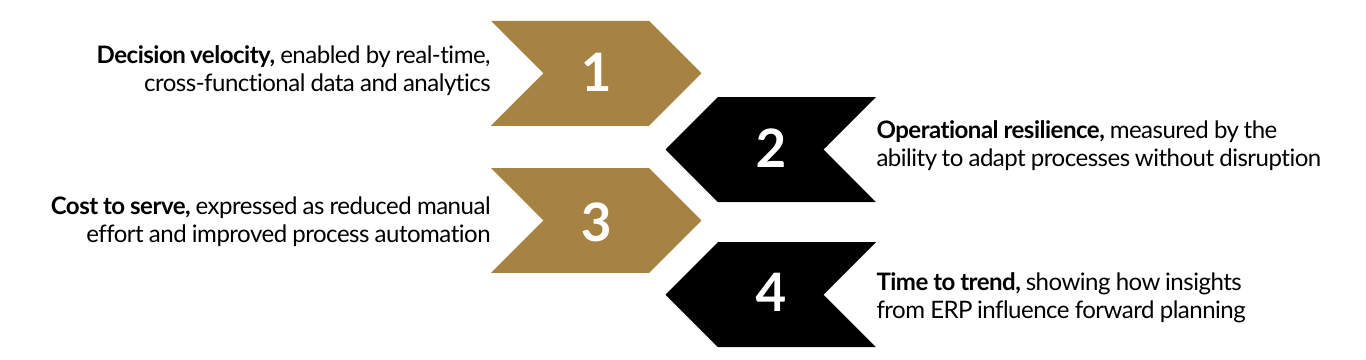
These metrics put ERP in a business context, elevating it from an IT efficiency driver to a strategic performance enabler.
Simplification as a Strategy for Faster Execution
One advanced principle of successful ERP execution is intentional simplification. Overly customized environments slow upgrades, create unnecessary complexity, and require heavy maintenance. Oracle Cloud, with a unified architecture and frequent innovation cycles, rewards companies that adopt standard configurations where possible and govern custom solutions judiciously.
Leaders must help teams prioritize:
.png?width=1000&height=467&name=Decision%20velocity%2c%20enabled%20by%20real-time%2c%20cross-functional%20data%20and%20analytics%20(1).png)
This deliberate simplification accelerates execution and improves the platform’s long-term maintainability.
Capability Building: People and Processes That Sustain Change
ERP execution success depends as much on people and processes as it does on technology. While the cloud reduces the burden of infrastructure management, it heightens the need for organizational capability.
C-suite priorities in this context include:
- Establishing strong ownership and accountability across business domains
- Developing change management frameworks that prepare the organization for rapid innovation
- Building internal subject-matter expertise that can interpret data and drive decision-making
- Ensuring continuity and retention of ERP and process knowledge
Capability building turns ERP from a system upgrade into an enterprise capability that enhances execution on key business priorities.
.png?width=394&height=399&name=Decision%20velocity%2c%20enabled%20by%20real-time%2c%20cross-functional%20data%20and%20analytics%20(2).png) Managing the ERP Ecosystem: Integration and Extension
Managing the ERP Ecosystem: Integration and Extension
Enterprise landscapes today are rarely monolithic. Cloud ERP must coexist with other systems, data platforms, analytics layers, industry-specific solutions, and partner ecosystems. Oracle Cloud’s integrated suite, spanning ERP, EPM, SCM, and HCM, gives leaders a powerful foundation. However, execution success also requires smart integration strategies.
This includes evaluating:
- Hybrid landscapes and two-tier ERP models for phased transformation
- The role of API-driven interoperability
- Data governance and master data alignment across systems
By treating ERP as part of an ecosystem, not a silo, leaders can prioritize integration approaches that extend value across the enterprise.
Guiding ERP Choice and Migration
For organizations still evaluating ERP options or considering migration paths to Oracle Cloud in 2026, the execution playbook begins with clarity on business needs, risk tolerance, and strategic growth expectations.
Data shows that a majority of enterprises have embraced cloud ERP in some form, with adoption trending above 60% for cloud modules and growing.These organizations typically realize cost efficiencies, improved IT agility, and measurable performance improvements compared with on-premises legacy systems. For C-suite leaders, this reinforces a core truth: cloud ERP is not merely a technology decision, it is a business differentiator.
Selecting an ERP platform should therefore be guided by:
.png?width=1000&height=362&name=Decision%20velocity%2c%20enabled%20by%20real-time%2c%20cross-functional%20data%20and%20analytics%20(3).png)
ERP modernization decisions in 2026 should be anchored in value realization rather than feature checklists.
Why Testing Has Become Central to ERP Execution
As ERP platforms have moved to the cloud, the role of testing has fundamentally changed. In on-prem environments, testing was often treated as a phase—completed before go-live and revisited only during major upgrades. That model no longer works.
Oracle Cloud’s continuous release cycle means ERP execution now depends on an organization’s ability to absorb change repeatedly and confidently. Every monthly patch and quarterly update introduces new behaviors across finance, supply chain, HR, and reporting. The question for leadership is no longer whether change will occur, but whether the organization can validate it without disruption.
This is where many ERP programs quietly struggle. Manual testing approaches that once sufficed become bottlenecks, slowing adoption and introducing risk at precisely the moment organizations want to move faster.
In 2026, testing is no longer a technical safeguard. It is an execution enabler. Organizations that invest in automated, intelligent testing are able to adopt new functionality with confidence, maintain operational stability, and preserve trust in the system. Those that do not often find innovation slowing under the weight of release risk.
For the C-suite, this reframes testing as a business concern—not an IT afterthought. Testing directly affects time-to-value, release confidence, and the organization’s ability to evolve its ERP environment without friction.
.png?width=190&height=191&name=Decision%20velocity%2c%20enabled%20by%20real-time%2c%20cross-functional%20data%20and%20analytics%20(4).png) Where KAPITAL Fits In
Where KAPITAL Fits In
At KAPITAL, we support organizations at every stage of their ERP journey—from early decision-making and platform evaluation, through migration and implementation, and into post-go-live optimization. We understand that ERP execution is not linear, and that leadership needs evolve as programs mature.
Our teams bring a combined experience of more than two decades working across complex ERP environments. That depth allows us to provide the right expertise at the right moment—whether an organization is assessing its future ERP direction, standing up a transformation program, stabilizing after go-live, or preparing for the next phase of optimization.
Beyond talent, we’ve also invested in strengthening how ERP programs execute at scale. Through Test Kapital, our partnership with Tricentis, we help organizations reduce manual testing effort by up to 90%, increase confidence during releases, and support continuous change through intelligent test automation. This ensures ERP environments remain stable, scalable, and ready to evolve.
Together, our approach brings people, process, and execution discipline into alignment—helping leaders move through ERP transformation with clarity, confidence, and sustained value creation.

